


The AI music invasion came in 2025; quiet and algorithmic. 2026 brings resistance; loud, human, and uncompromising.
On January 13, 2026, Bandcamp Support posted a simple message that reverberated across the music industry! AI-generated music was no longer welcome on their platform.
“We want musicians to keep making music, and for fans to have confidence that the music they find on Bandcamp was created by humans,”
the company declared. And within days, the floodgates opened.
Sweden disqualified an AI-assisted folk-pop song from its official charts despite millions of streams. Nearly 800 artists, including Cyndi Lauper and Bonnie Raitt, signed an open letter against AI music with a blunt message:
“Stealing isn’t innovation.”
Meanwhile, AI music generator Udio was busy signing a licensing deal with Merlin, who represent independent artists in over 70 countries. Remember, Udio already signed licensing deals with major labels in 2025.
These aren’t just some controversial music industry stories to start the year with. It’s a watershed moment that will determine whether music remains a fundamentally human art form or becomes another dataset for machines to process and replicate.
Bandcamp Plants Its Flag
Bandcamp’s decision to ban AI-generated content makes it the first major music platform to take such a definitive stance. The policy is comprehensive.
Any music or audio “generated wholly or in substantial part by AI” is prohibited, and using AI tools to impersonate other artists or styles is strictly forbidden.
The platform has empowered its community to police this boundary, encouraging users to report suspicious uploads for review.
The timing is deliberate. After releasing its 2025 year-in-review, Bandcamp said it was struck by
“the sheer quantity of human creativity and passion that artists express on Bandcamp every single day.”
For a platform that has built its reputation on supporting independent musicians and paid out over $1 billion to artists since its founding; the AI ban isn’t just policy, it’s a philosophical bedrock.
Sweden’s Chart Revolution
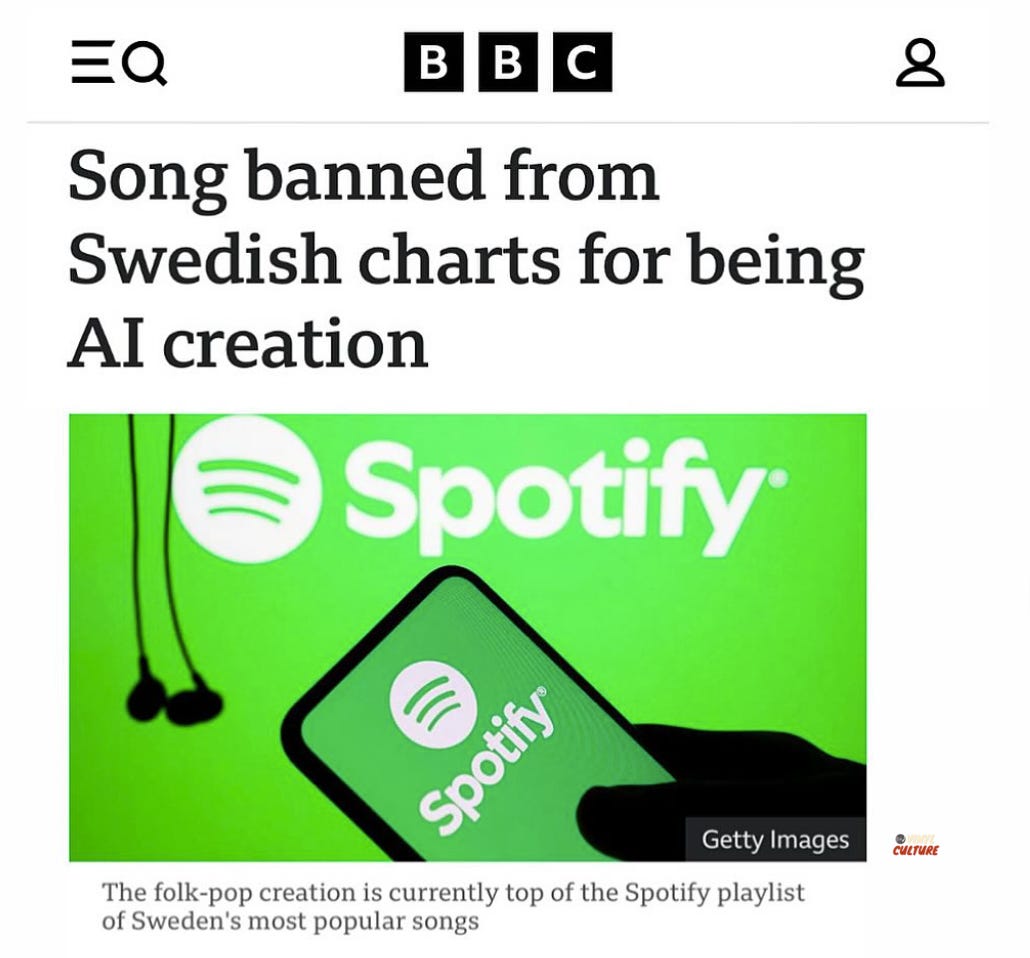
Days after the Bandcamp announcement, Sweden made headlines with an equally significant decision. “I Know, You’re Not Mine” (”Jag Vet, Du Är Inte Min”), a folk-pop song by an artist called Jacub, had topped Spotify’s domestic rankings in Sweden and accumulated millions of worldwide streams. But investigative journalist Emanuel Karlsten revealed that
the track was partly AI-generated and registered to a Danish music publisher where two credited rights holders work in the company’s AI department.
IFPI Sweden, the organization responsible for the country’s official charts, swiftly disqualified the song.
“Our rule is that if it is a song that is mainly AI-generated, it does not have the right to be on the top list,”
explained CEO Ludvig Werner.
This decision raises some important questions about transparency and disclosure in an era where AI is increasingly used as a tool in creative industries. How much AI assistance disqualifies a work as “human”? Where is the line between AI as an instrument/ tool and AI as the creator?
The Other Side of Streaming
While platforms like Bandcamp draw hard lines against AI, Spotify continues to raise prices while maintaining policies that shortchange human artists. In January 2026, Spotify announced it would increase its U.S. Premium subscription from $11.99 to $12.99 per month; the second increase in 18 months.
The Premium Duo tier will jump to $18.99, Family to $21.99, and even the Student plan rises to $6.99.
Yet artists themselves see none of this increased revenue. Spotify’s controversial 2024 policy requiring tracks to reach at least 1,000 streams before generating any royalties remains in effect. While Spotify claims this policy redirects $40 million toward “eligible” artists and prevents money from sitting unused in accounts below distributor payout thresholds, many argue it simply allows the platform to pocket revenue while enriching already-successful artists at the expense of emerging talent.
The optics are devastating!!
Spotify raises prices on listeners while maintaining a threshold that ensures many human artists earn literally nothing while AI-generated music floods streaming platforms.Udio’s Licensing Strategy
Despite the resistance from platforms and artists, AI music generator Udio is trying to attain legitimacy through licensing. On January 20, 2026, Udio announced a landmark partnership with Merlin, the digital licensing agency representing independent labels and distributors in over 70 countries. This deal follows earlier settlements and licensing agreements with Universal Music Group and Warner Music Group, both of which had sued Udio in 2024 for allegedly using copyrighted recordings without authorization.
The structure represents a fundamental shift in Udio’s business model. Rather than generating entirely new songs from text prompts which users could download freely; Udio is transitioning to a “walled garden” approach focused on remixing and personalizing licensed, existing songs. The company plans to phase out its current model in 2026, restricting users from exporting AI-generated tracks outside the platform. Artists who opt in will receive some compensation for their music being used in AI training, with terms designed to protect “human artistry.”
For Merlin CEO Jeremy Sirota, the partnership reflects pragmatism;
“As AI evolves, it is vital for Merlin to collaborate with partners who honour artists, their creations, and the necessity of music licensing.”
Sony Music remains the only major label without a licensing deal with Udio, its lawsuit still ongoing. Although, they have already signed a licensing deal with Klay Vision, a Los Angeles-based AI music startup.

“Stealing Isn’t Innovation”
Not everyone is satisfied with licensing as a solution. On January 22, 2026, the Human Artistry Campaign; a coalition formed in 2023 by the Recording Industry Association of America (RIAA) and the National Music Publishers’ Association (NMPA) launched “Stealing Isn’t Innovation,” a campaign backed by nearly 800 artists, writers, and performers.
The signatories read like a who’s who of music;
Cyndi Lauper, Bonnie Raitt, Jennifer Hudson, LeAnn Rimes, R.E.M., OneRepublic, MGMT, and even actress Scarlett Johansson.
Their message is uncompromising:
“Profit-hungry technology companies, including those among the richest in the world as well as private equity-backed ventures, have copied a massive amount of creative content online without authorization or payment to those who created it.”
The campaign’s open letter stresses that licensing deals offer a viable path forward but only when AI companies actually pursue them voluntarily rather than scraping content first and negotiating later.
“A better way exists. Through licensing deals and partnerships, some AI companies have taken the responsible, ethical route to obtaining the content and materials they wish to use,”
the letter states. The implicit critique is that too many AI companies have treated copyright as an inconvenient obstacle rather than a fundamental right.
What This Means for Music’s Future
January 2026 may be remembered as the month when part of the music industry finally found its voice on AI. The convergence of Bandcamp’s ban, Sweden’s chart disqualification, Spotify’s price hikes, Udio’s licensing deals, and the “Stealing Isn’t Innovation” campaign reveals an industry grappling with existential questions.
The battle lines are clear. On one side;
Platforms and artists insisting on human authorship, transparency, and fair compensation.
On the other;
AI companies seeking to legitimate their technology through licensing while streaming platforms maximize profits regardless of who, or what creates the content.
But the most important questions remain unanswered. If artists license their work for AI training, are they signing away their creative futures? If AI music becomes almost indistinguishable from human music, will listeners care about the difference? And in a world where streaming platforms pay pennies while charging more, can human musicians even afford to compete?
A part of the music industry has drawn its line. Now comes the hard part:
HOLDING THE LINE
🫵🏼 What’s YOUR take? Should platforms ban AI music entirely, or is licensing a reasonable compromise? Does your answer change if most human artists struggle to pay rent while the AI companies make billions? Would YOU prefer a streaming platform with a strict ban on AI music?
💬 Share your thoughts below & share this investigation with every artist and music fan you know. The future of human creativity depends on holding these companies accountable. Consider supporting artists directly through platforms like Bandcamp, where musicians set their own prices and keep a fair share of revenue.
🤝🏼 Join us at Vinyl Culture as we continue exploring ways to preserve and evolve an authentic music culture in an age dominated by algorithms and corporate interests. We are building something that will revolutionize the music industry by creating an Artist-centred and Community-driven platform, leveraging both the offline & online medium. We will empower artists by allowing them to share their art and creativity directly with the fans. More on this soon…
5️⃣0️⃣0️⃣0️⃣+ SUBSCRIBERS have now joined our mission to protect The Soul of Music in the age of algorithmic manipulation & AI. Thanks a lot to each & every one of you!! 🫵🏼 🤝🏼🙌🏻 Together, we can make a difference.


A great read!
By its nature, AI music is average - derivative - good enough. The issue is, with scale and generational increments, it will evolve to be the ultimate POP songwriter/producer. I truly believe this, mostly because the idea of "hit song writing" is essentially slow-AI-like behaviour. My last Substack article goes into depth on this... we will not be able to compete.
What this will create however is a world RIPE with expression, unhinged creativity, nuance and niche. It will be the ONLY thing that matters, once we live in an infinite-media world. Our art will be gold coins on a never-ending beach - and Bandcamp will be our metal detector.
Great article and kudos to Bandcamp.
I just cannot get on board with AI generated music - call me a luddite - but AI is not authentic music