


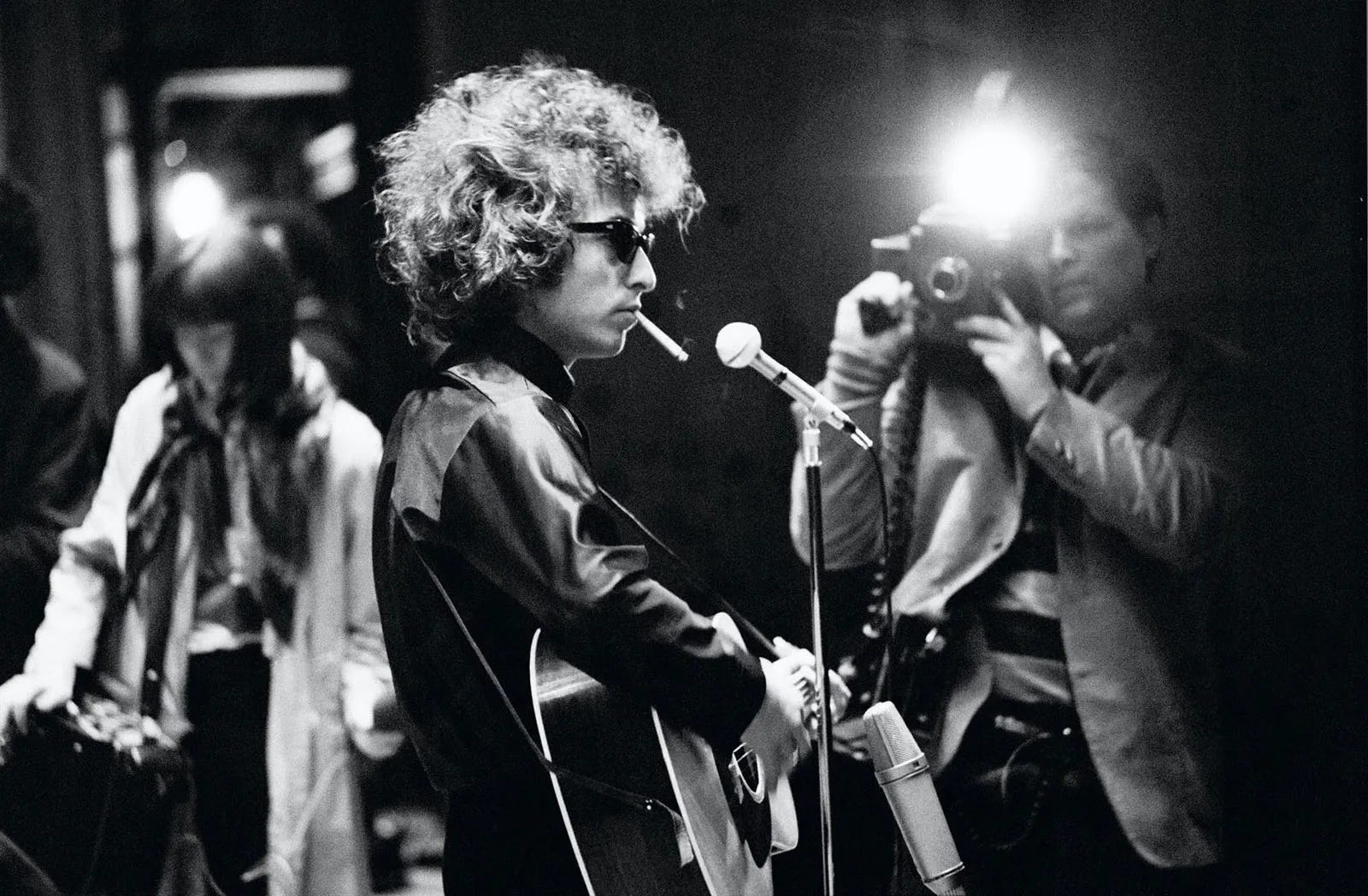
In the smoky basement of a Greenwich Village coffee house circa 1965, a young Bob Dylan would finish his set to the gentle clink of coins dropping into a wicker basket passed among the audience. The folk club tradition was simple:
Artists performed their hearts out, and grateful listeners contributed what they could afford.
It was imperfect, but it was honest! A direct connection between artist and audience with no corporate middleman skimming profits.
Fast-forward to 2025, and we find ourselves in a dystopian inversion of that world. Singer-songwriter Tomberlin stood on stage at Wolf Trap, one of America's most prestigious venues, having just delivered a captivating performance to a packed amphitheatre. But instead of collecting donations, she was asked to pay the venue 41% of her merchandise sales; a staggering tribute that would make medieval tax collectors blush.
This isn't just the story of how the music industry changed. This is the story of how the world abandoned its artists.The pay-to-play pandemic that began as a regional scourge in 1980s Los Angeles has metastasized into a worldwide crisis that's not just exploiting individual musicians but is systematically eliminating the pipeline that has given us every breakthrough artist of the past century.
The Mathematics of Artistic Extinction
The Visa Apocalypse
Let's start with the most brutal number:
Artist visa costs increased from $460 to $1,615 in 2024! This is a 251% increase that represents the single largest barrier to international artistic exchange in American history.
For a five-piece band, that's over $8,000 before they've played a single note on American soil.
But what makes this particularly insidious is that this increase wasn't driven by inflation or administrative costs. It was driven by the same mentality that created pay-to-play venues, i.e. the belief that artists are revenue sources to be mined rather than creative engines that drive cultural and economic value.
The National Independent Venue Association warned that these fees would pose
"a severe economic and cultural threat to independent live entertainment across the nation.”
They were right. The result is a systematic exclusion of international artists who can't afford to mortgage their financial futures for a chance at American exposure (the largest live music market globally.)
But America isn't alone in creating these barriers.
European touring requires a carnet (a declaration of goods through customs) that costs nearly £800 before artists even leave their home country.
Add ferry costs, tolls, fuel, and accommodation, and a 24-day European tour can cost upwards of £34,000 of the band's own money; which is equivalent to a house deposit in many cases.
The Merchandise Stranglehold
While visa costs create barriers to entry, merchandise cuts create ongoing extraction systems that make touring financially impossible for most artists. Venue merchandise cuts range from 10% to 40% of sales, with some venues like Wolf Trap demanding 41% of artist merchandise revenue.
The mathematics are devastating. As one analysis breaks down:
At a 30% venue cut plus 8% taxes plus 15% management fees, artists retain just around 43% of gross merchandise profits,
and that's before accounting for the costs of designing, manufacturing, and shipping the merchandise.
When musicians like Exodus guitarist Gary Holt describe modern touring as being "traveling T-shirt salesmen," he's not exaggerating. Merchandise often represents the only profitable aspect of touring for emerging artists. When venues take substantial cuts of these sales, they are literally extracting the gas money needed to reach the next city.
The Corporate Expansion Paradox
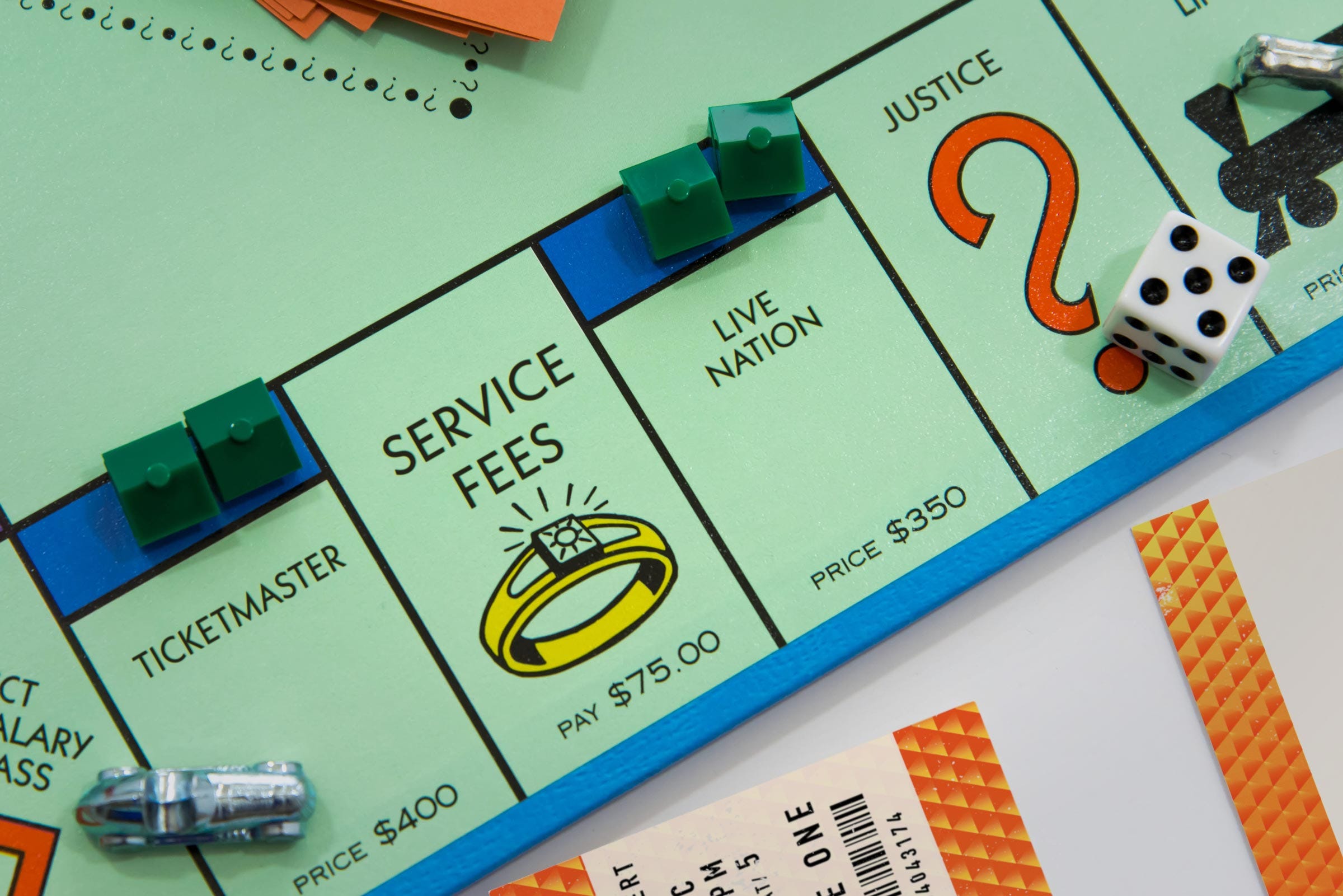
In June 2025, Live Nation announced the most aggressive expansion in its history!
$1 billion invested in 18 new venues across the United States. The company projects this will generate $2.9 billion in direct economic activity and $1.4 billion in annual spending once operational.
But here’s a paradox! More venues should mean more opportunities for artists, right? Nope. Instead,
Live Nation's temporary merchandise cut waiver program from 2023 quietly ended, returning to standard industry practices at most venues.
The brief reprieve was widely criticized as a publicity stunt rather than genuine reform.
Live Nation's vertical integration strategy continues to eliminate alternatives for touring musicians. By controlling venues, promotion, ticketing through Ticketmaster, and artist management, they have created a system where artists have little choice but to accept whatever terms are offered.
The Human Cost | A Generation of Artists Going Extinct
The Touring Collapse
The most shocking statistic isn't about ticket prices or venue cuts. In fact, it's about survival. Between 2022 and 2024, the share of mid-level touring artists decreased from 19% to 12%. Among superstars, touring numbers dropped from 44% to 36%.
This isn't just a post-pandemic adjustment. High-profile artists like Jennifer Lopez, The Black Keys, and Lauryn Hill & The Fugees all canceled tours in 2024 due to low ticket sales. When established acts with decades of experience and loyal fanbases can't make touring work financially, it reveals the depth of the systemic problem.
The Streaming-Touring Death Spiral
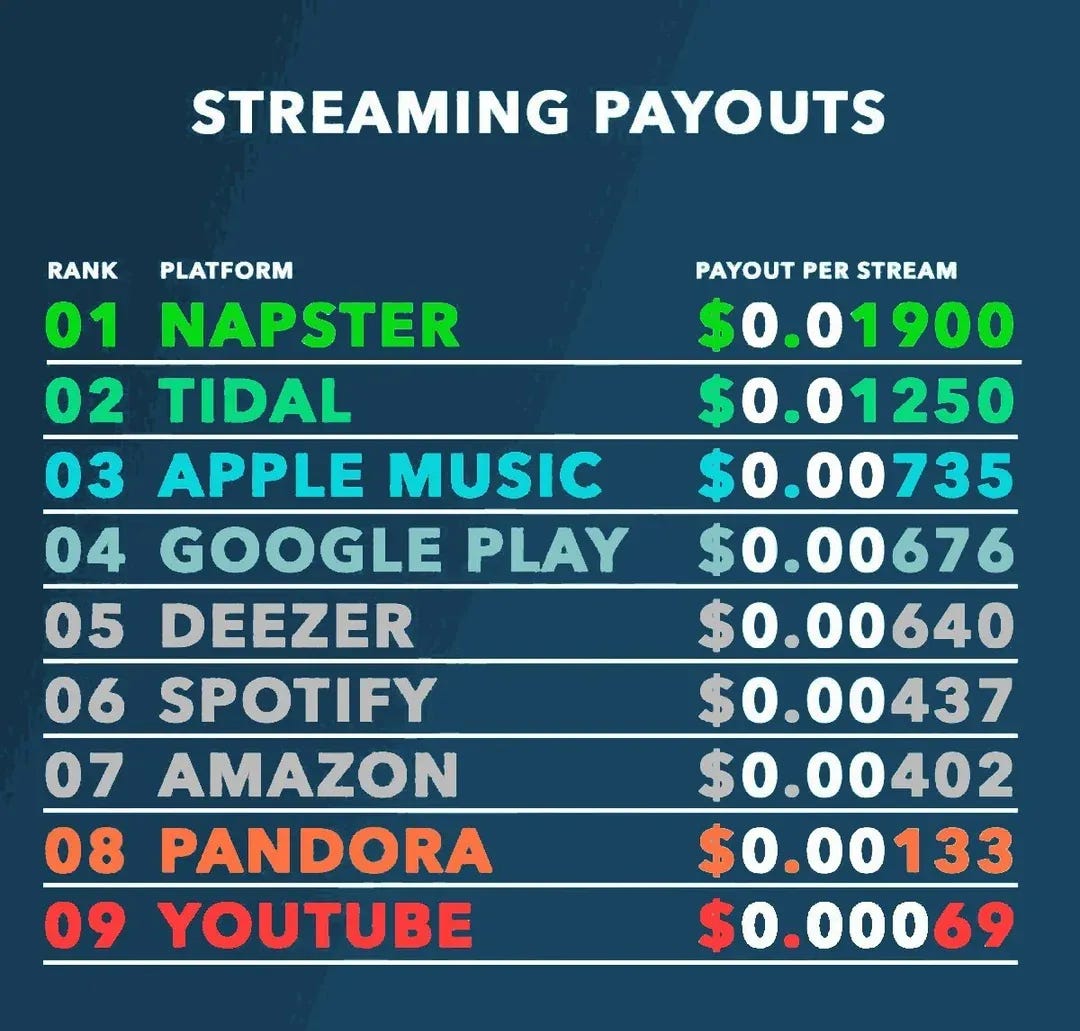
Concert ticket prices have risen 20% since 2021, while streaming payouts remain negligible. Artists need touring income more than ever, but touring has become financially impossible for all but the most established acts.
This creates a vicious cycle where artists can't afford to tour to build audiences, but they can't build audiences without touring.
The numbers are stark when broken down per song. Premium concert experiences now cost fans over $16 per song performed, with some artists charging $3.55 per minute of performance time. While these figures reflect superstar pricing, they illustrate how disconnected live music economics have become from artist sustainability.
The Historical Context | How We Got Here
From Community to Commodity
The folk club movement of the 1950s and 60s represented something revolutionary! Venues existed primarily to support artists, not exploit them. These spaces operated on a simple principle that artists deserve to be paid for their work, even if it was just what the audience could spare.
The pay-to-play system began in 1980s Los Angeles, where by 1989, as many as 800 bands were paying club promoters $1,000 or more just for the “privilege” of performing. What started as a regional exploitation scheme has become the international standard.
The Consolidation Connection
The venue consolidation crisis mirrors the streaming platform monopoly in disturbing ways. Just as Spotify and Apple Music gained monopolistic control over music distribution, Live Nation has systematically acquired venues, promoters, and ticketing companies to create a stranglehold on live music.
Just as major labels initially resisted digital distribution only to be displaced by tech companies that now control 80% of music consumption, traditional independent venues are being displaced by corporate consolidators.
Dr. Sam Whiting of RMIT University explains:
"Such large-scale consolidation means that many independent artist managers, promoters and ticketing companies can't compete. As Live Nation controls multiple parts of the supply chain, many artist tours are obliged to work with them if they want to operate at scale."
This creates what economists call "vertical integration;" where a single company controls multiple levels of an industry. For emerging artists, this means fewer independent venues willing to take risks on unknown acts, and more corporate-controlled spaces focused on maximizing revenue extraction.
The Resistance | Signs of Hope in Dark Times
The Manchester Model
Tim Burgess of The Charlatans offered a glimpse of what the future could look like with his 2025 Manchester Merch Market. This was an event where bands can sell merchandise with zero commission, keeping 100% of their income. This simple concept represents a radical challenge to venue exploitation practices.
"It's about fairness rather than money,"
Burgess explained. His proposal to venues was simple.
“If you want a cut of our merchandise, perhaps we should get a cut of your bar sales.”
This logic exposes the fundamental unfairness of current arrangements.
The Growing Movement
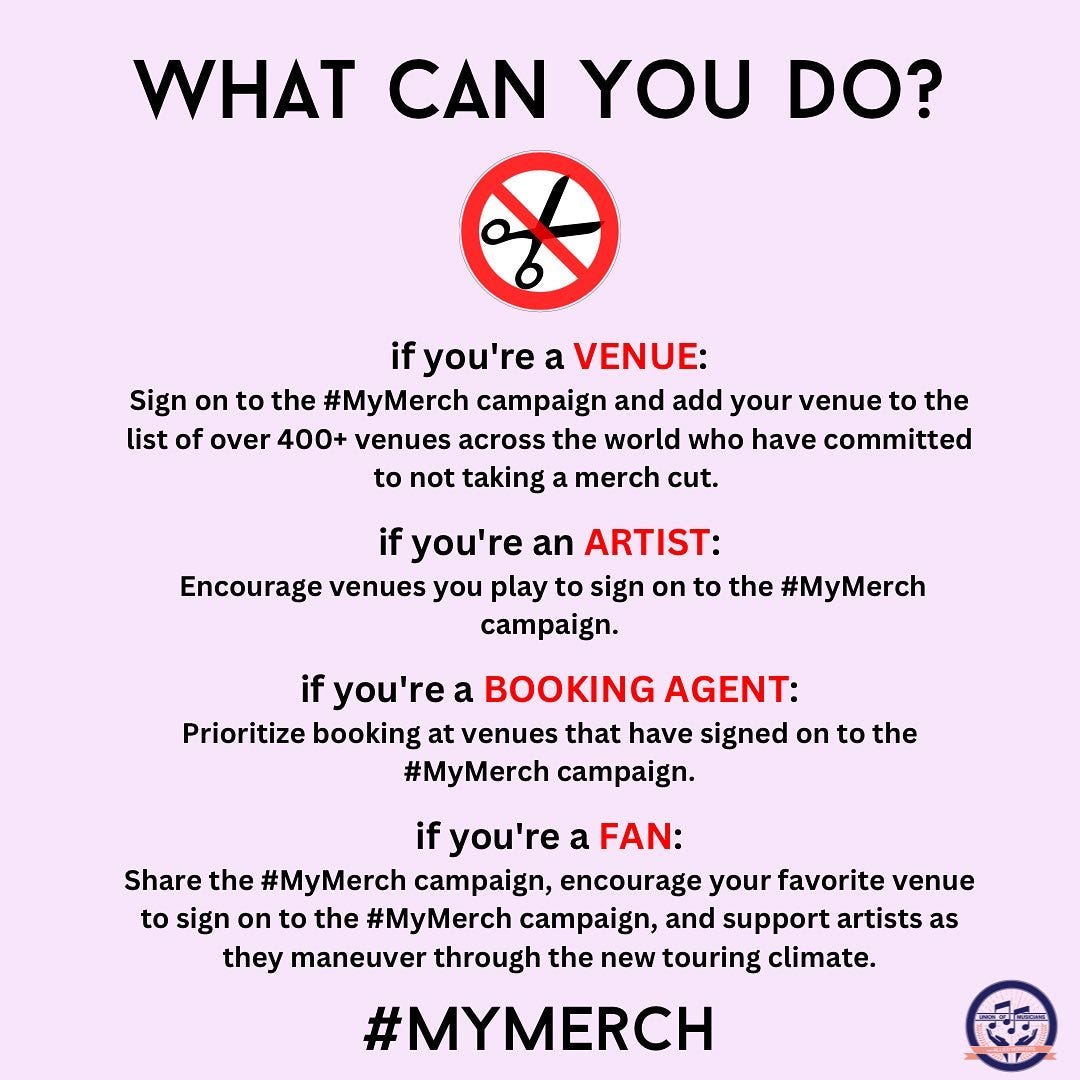
The 100% Venues campaign continues to grow, maintaining a database of venues committed to zero merchandise cuts. While progress is gradual, the movement represents artists finally organizing to collectively reject exploitative practices.
The #MyMerch campaign has convinced over 400 venues worldwide to commit to not taking merchandise cuts. The campaign's power lies in its simplicity! When enough artists refuse to accept venue cuts, venues will be forced to change their practices or lose performers entirely.
Legislative Pressure
The ongoing U.S. Department of Justice investigation into Live Nation's monopolistic practices gained momentum in 2025. The antitrust lawsuit, began under the Biden administration and continues under the Trump presidency, with a public inquiry into "unfair and anti-competitive practices in live ticketing" that received public comments through July 2025.
The Choice That Defines Our Cultural Future
The Extinction Event
We are witnessing the systematic elimination of artistic diversity in the world.
When 82% of independent artists cannot afford to tour beyond their local area, we're not just losing individual musicians; we are losing the voices that challenge conventions, the sounds that define generations, and the cultural movements that re-shape society.
The artists who can't afford to pay $1,615 for a visa or $500 for pay-to-play slots are exactly the ones whose voices we need to hear most. They are the ones with something to say, the ones who haven't been sanitized by corporate focus groups, the ones who create the art that actually matters.
The streaming revolution already decimated artist income from recorded music. The venue consolidation crisis is now eliminating income from live performance.
When both revenue streams are controlled by monopolistic entities focused on extraction rather than creation, we are witnessing the end of professional musicianship as a viable career path.
The Revolution Starts With The Power of NO
Every time an artist accepts a pay-to-play gig or agrees to a 25% merchandise cut, they are not just compromising their own financial future; they are normalizing exploitation for every artist who comes after them.
The resistance starts with a simple word: NO.
NO to venues that demand payment for the privilege of performing. NO to merchandise cuts that extract survival money from struggling artists. NO to visa fees that exclude international voices from American stages. NO to a system that treats artists as revenue sources rather than cultural creators.
The Call to Action
This isn't just about musicians; it's about the kind of society we want to live in. Do we want a cultural landscape where only the wealthy can afford to create? Where artistic expression is determined by corporate spreadsheets rather than human creativity? Where the next music prodigy never gets past the visa application because they can't afford the $1,615 fee?
Every time you attend a concert, you're voting for the future of music.
Support venues that treat artists fairly. Boycott those that don't.
Demand transparency about where your ticket money goes.
Ask venues about their merchandise policies and make it clear that you disapprove of exploitative practices.
The folk clubs of the 1960s understood one fundamental truth:
The ARTIST is the reason the entire ecosystem exists.
The basket may be gone, but the principle remains! Artists deserve to be supported, not exploited. The question is whether we'll choose to remember that before the last independent musician closes their tour case forever…
✊🏼 The revolution doesn't require dramatic gestures. It just requires saying NO to exploitation, one venue at a time. Share this article with every artist and music fan you know. The information revolution starts with YOU.
🤝🏼 Join us at Vinyl Culture as we continue exploring ways to preserve and evolve an authentic music culture in an age dominated by algorithms and corporate interests. We are building something that will revolutionize the music industry by creating an Artist-centred and Community-driven platform, leveraging both the offline & online medium. We will empower artists by allowing them to share their art and creativity directly with the fans. More on this soon…
1️⃣0️⃣0️⃣0️⃣+ SUBSCRIBERS have now joined our mission to protect The Soul of Music in the age of algorithmic manipulation & AI. Thanks a lot to each & every one of you!! 🫵🏼 🤝🏼🙌🏻 Together, we can make a difference.


I was unaware of the #MYMERCH campaign, but am going to check it out now. Great piece, & well put together, as always. I played a venue this past spring in Florida that insisted on a 20% merch cut. Thankfully, the guaranteed performance fee was solid, so I decided to not sell any merch at that show. LOL. I had contemplated raising my merch prices by 20% & putting a sign on the table explaining why, but again .... the guarantee was a good one, so I just skipped the merch.
Oh man I had no idea, that sucks. I always try to buy a tshirt or a vinyl on a live gig, thinking I was supporting the artists, and turns out I was just supporting them in 60% 🫠
Interesting read, thanks for sharing!