


We knew 2025 would be pivotal for the music industry, but no one predicted just how quickly the foundation would crack. What began as lawsuits defending artists’ rights ended in boardroom handshakes worth billions. What started as concerns about AI became a full-scale invasion, with 97% of listeners unable to distinguish synthetic music from human creativity. And what musicians hoped would be a year of reform became twelve months of systematic dismantling of the creative class.
2025 tells a story of an industry that chose profits over people, algorithms over artistry, and synthetic content over human soul. As we close the chapter on 2025 and look toward 2026, one thing is devastatingly clear…
MUSIC is changing FOREVER, and it’s probably going to get WORSE before it gets BETTER.
What Actually Happened in 2025 | The AI Takeover
The Great Corporate Surrender
The year’s defining narrative was watching major labels transform from litigators to collaborators in record time. In June 2024, Universal Music Group, Warner Music Group, and Sony Music Entertainment filed aggressive lawsuits against AI music generators Suno and Udio, accusing them of “massive copyright infringement” by training on artists’ catalogs without permission.
By October 2025, Universal had settled with Udio and announced a partnership. Three weeks later, Warner followed suit with both Suno and Udio. The pattern was unmistakable:
Sue for leverage, Negotiate for profit, Settle for partnership.
Meanwhile, all three majors simultaneously signed deals with Klay Vision, a mysterious Los Angeles AI music startup most people have never heard of.
The lawsuits were never about protecting artists from AI; they were about ensuring labels controlled the terms of AI’s access to those artists. As Warner CEO Robert Kyncl candidly admitted,
“With Suno rapidly scaling, both in users and monetization, we have seized this opportunity to shape models that expand revenue.”
Translation: If you can’t beat them, take a cut of their $200 million in annual revenue.The Perception Crisis
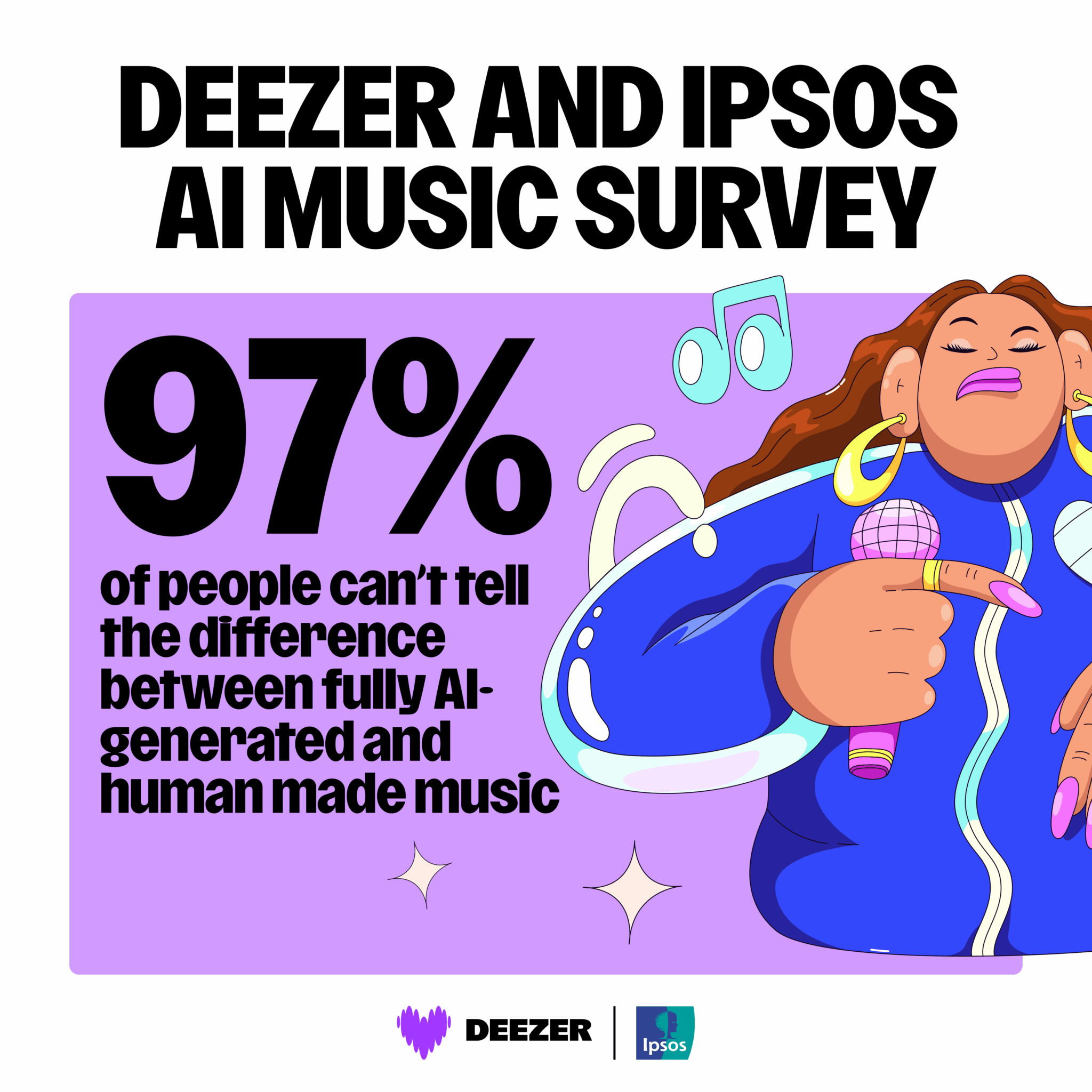
While labels negotiated behind closed doors, a shocking study revealed how far the transformation had progressed. In November 2025, Deezer partnered with Ipsos to poll 9,000 people across eight countries regarding AI music perception. The results should alarm anyone who cares about human creativity!
97% of respondents could not distinguish between fully AI-generated music and human-made songs in blind listening tests.
When participants learned they had been fooled, 71% expressed surprise, and 52% felt uncomfortable knowing they couldn’t tell the difference. The disturbing implication? If listeners can’t identify synthetic music and platforms won’t label it, then human artistry becomes functionally invisible in the marketplace.
And the flood has already begun. Deezer receives over 50,000 fully AI-generated tracks daily; that’s 34% of all daily music deliveries to the platform. This represents an acceleration from the 28% figure we documented weeks earlier.
The Economic Extinction Event
The numbers behind the AI invasion are devastating. A ground-breaking global study by CISAC (International Confederation of Societies of Authors and Composers) delivered a stark warning.
24% of musicians’ income could vanish by 2028, while tech companies reap billions from AI-generated content trained on artists’ work without their permission.
Music creators face a cumulative loss of $10-10.5 billion between 2023 and 2028, with annual losses reaching $4-4.2 billion by 2028 alone. Meanwhile, the market for generative AI music content is projected to explode from $3-3.2 billion today to a staggering $64-68 billion by 2028. Every dollar flowing to AI platforms represents potential income diverted from human creators who spent years developing their craft.
And in another particularly cruel twist, SoundExchange’s artist underpayment estimate against SiriusXM ballooned from $150 million to over $400 million during 2025. That is a quarter-billion-dollar increase while courts debated methodology.
Daniel Ek’s Exit and Spotify’s Dark Truth
In perhaps one of the year’s most symbolic moment, Spotify founder Daniel Ek announced he would step down as CEO on January 1, 2026, transitioning to Executive Chairman. His departure caps two decades of prioritizing profits over artists, transforming music from art into data, and listeners into products to be sold to advertisers.
The year also exposed Spotify’s Perfect Fit Content scandal, where the platform commissioned low-cost “fake artists” to populate its most popular playlists, displacing established musicians while maximizing profit margins. Meanwhile, Ek poured over $600 million into Helsing, a German defense company developing AI-powered military drones; using money generated by artists to fund weapons technology.
The ethical contradiction sparked an artist exodus. Bands like King Gizzard & The Lizard Wizard, Deerhoof, and Xiu Xiu pulled their catalogs from the platform. Ironically, when King Gizzard… left Spotify in July 2025, AI-generated clones under names like “King Lizard Wizard” appeared within months, actively promoted by Spotify’s own recommendation algorithm.
AI Artists Hit the Charts
The theoretical became terrifyingly real in November 2025 when Xania Monet became the first AI-powered artist to debut on a Billboard airplay chart. The track topped the R&B Digital Song Sales chart and amassed 44.4 million official U.S. streams, generating over $52,000 in revenue. In September, Monet secured a $3 million recording contract after what Billboard described as a “bidding war.”
For consecutive weeks, at least one AI-generated artist appeared on Billboard charts.
Most don’t disclose their synthetic nature in streaming platform descriptions.

What’s Coming in 2026 | Predictions and Preparations
The AI Music Platform Explosion
By mid-2026, we’ll see the first major label-endorsed AI music generators trained on copyrighted catalogs go live. These tools will carry legitimacy that unauthorized platforms lack, potentially dominating the market while labels collect royalties and equity appreciation.
Expect at least one AI-music-only streaming platform to launch, where human-created music won’t be allowed.
This segregation will create a two-tier system where premium “human-made” music competes against an infinite flood of “good enough” synthetic content.
Deepfake Artist Hits and Identity Theft
Building on 2025’s foundation, 2026 will see our first major hybrid artist utilizing generative audio in a algorithmic, performative and repeatable manner. This won’t just be a news story but a real charting artist with tours, merchandise, and dedicated fanbases.
Voice cloning technology will create increasingly sophisticated “deepfake” hits using deceased or unwilling artists’ voices. Despite legislation like Tennessee’s ELVIS Act, enforcement will lag behind technological capability. Underground AI music generators will emerge from regions lacking regulation in a “whack-a-mole” scenario.
Royalty System Shakeups
The current pro-rata streaming model will face mounting pressure as AI-generated content floods platforms. Artists will demand transparency about how revenue is divided between human and synthetic creators.
Expect proposals for “user-centric” payment models where your subscription fee goes directly to artists you actually listen to. Whether major labels and platforms adopt these reforms remains doubtful as they benefit too much from the current opacity.
The Renewed Focus on Human Artistry
Paradoxically, AI’s invasion will spark a counter-movement celebrating irreducible human creativity. Expect increasing exhaustion toward over-produced, safe aesthetics found in AI music and a hearty start to anti-AI music production featuring unique and experimental productions.
Artists who can prove their humanity through live performance, transparent creation processes, and direct fan relationships will command premium value. Platforms like Bandcamp, which allow artists to set their own prices and keep fair revenue shares, will see growth.
Physical media will experience a resurgence. Vinyl sales already surged in 2025; by 2026, records, albums, and CDs might become statements of resistance against algorithmic culture.
The Great Migration
2026 will witness accelerating artist migration away from traditional streaming. Expect new platforms to appear. Artists will build direct subscription models, fan communities, and alternative revenue streams that bypass corporate gatekeepers entirely.
Those who remain on major platforms will face intensified surveillance.
Spotify’s November 2025 acquisition of WhoSampled (the world’s largest database tracking music samples, covers, and remixes) positions the platform as arbiter of musical legitimacy and copyright enforcement.
The Fight Ahead | It’s Time for Action
Music is changing forever. The transformation from litigation to capitulation took less than 18 months. The elimination of human musicians is happening faster than anyone expected. The corporate playbook is clear;
Devalue human creativity, flood markets with synthetic alternatives, pocket the difference.
What’s missing is a collective action from artists, fans, and policymakers who refuse to accept this future.
Every subscription dollar is a vote for the kind of culture we want. Every stream shapes the algorithm. Every purchase decision determines whether human creativity survives or becomes a luxury only the wealthy can afford. The stakes extend far beyond individual artist income.
Music reflects human culture, emotion, and experience in ways artificial intelligence cannot replicate.
While AI might be able to generate technically proficient compositions, it cannot capture the lived experiences, cultural contexts, and emotional authenticity that make music meaningful.
The question isn’t whether AI will continue advancing in music creation. It will. The question is whether we’ll structure this advancement to support human creativity or replace it entirely.
For artists, musicians, and everyone who believes human expression matters; 2026 will demand you to make choices. Where you stream, what you support, and how loudly you speak will determine the future we build. The future of music is being written right now, in boardrooms and courtrooms, on streaming platforms and in venture firms. Whether that future includes space for human creativity depends on what we do next.
Human music isn’t dead. But it needs DEFENDING.
🙏🏼 Thank you for supporting Vinyl Culture throughout 2025. In a year that tested every assumption about music’s future, your engagement kept this investigation going. As we enter 2026, the need for informed, critical coverage of the music industry has never been more urgent.
🔁 If you are a musician, creator, or music lover concerned about these issues, please share Vinyl Culture with your community. The industry is changing faster than most people realise, and staying informed isn’t optional; it’s survival.
🫵🏼 What do YOU predict for 2026? Are you worried about AI music? How will you support human artists? Drop your thoughts in the comments below. This conversation belongs to all of us.
Stay tuned. Stay informed. Stay human.
Happy New Year!!
🤝🏼 Join us at Vinyl Culture as we continue exploring ways to preserve and evolve an authentic music culture in an age dominated by algorithms and corporate interests. We are building something that will revolutionize the music industry by creating an Artist-centred and Community-driven platform, leveraging both the offline & online medium. We will empower artists by allowing them to share their art and creativity directly with the fans. More on this soon…
4️⃣5️⃣0️⃣0️⃣+ SUBSCRIBERS have now joined our mission to protect The Soul of Music in the age of algorithmic manipulation & AI. Thanks a lot to each & every one of you!! 🫵🏼 🤝🏼🙌🏻 Together, we can make a difference.


Very discouraging on the one hand but if you look beneath the surface of the major labels, there is an absolute glut of(and I use that in a good way) amazing music being made by musicians and producers who the majors will never have the slightest interest in, and that's a good thing. So while AI slop is a nightmare problem, let's not forgot how much amazing HUMAN made music there is and find ways to support it!
Dude, first of all thank you for this post! “The question is whether we’ll structure this advancement to support human creativity or replace it entirely.”
On this point: first of all human creativity it is infinite. So nothing can replace infinity. I see this as forgery, like those people that paint fake Van Gogh’s, etc. The forgery market exists parallel to the original painting market.
The difference with a.i. music here is the level of mass production in comparison with the fake paintings and the greediness level of the music publishers/platforms.
A good solution can be the clear labelling of ai music vs human made music, streaming platforms like Bandcamp that clearly helps musicians, musicians/artists that have their own website where people can go and listen/buy their music, and ultimately, the good old gigs/concerts in person to make sure you are real!