


The announcement came with typical corporate polish:
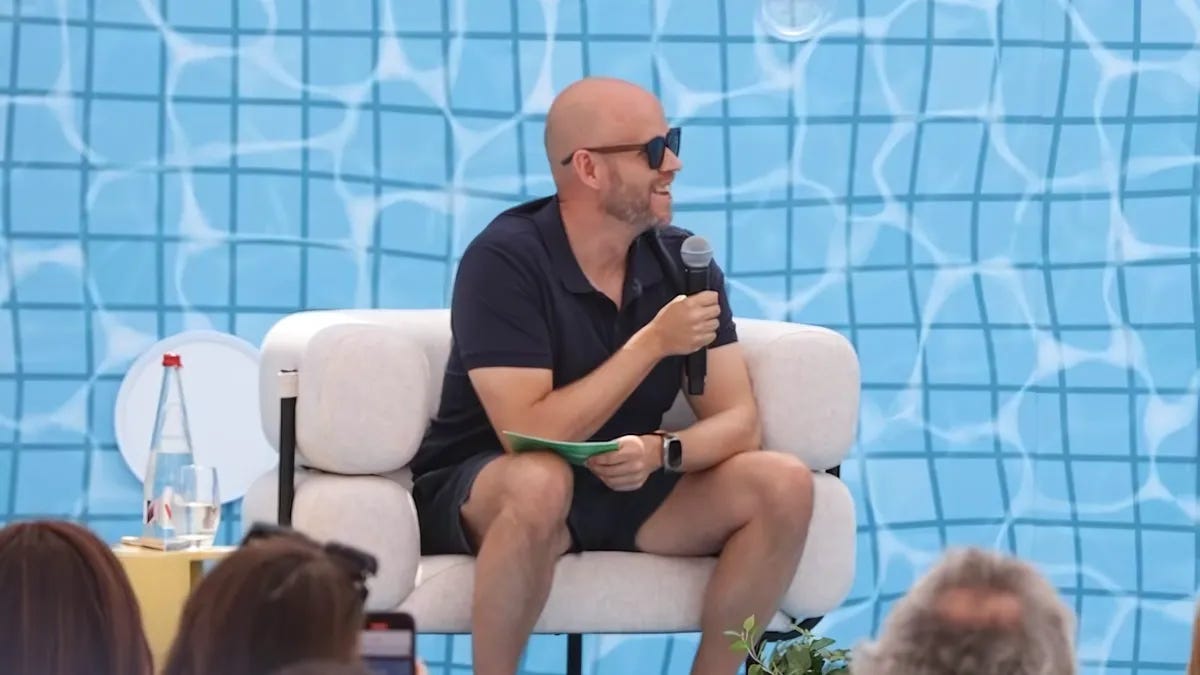
Daniel Ek, Spotify’s founder and CEO of nearly two decades, would “transition” to Executive Chairman on January 1, 2026, while two business executives would take the reins as co-CEOs.
But beneath the sanitized press release lies a more troubling story; one that music journalist Liz Pelly has been documenting for years, revealing how Spotify systematically transformed music from art into data, artists into content suppliers, and listeners into products to be sold to advertisers.
Ek’s departure isn’t just a changing of the guard; it’s the completion of a long-brewing transformation that has fundamentally altered the music industry’s relationship with creativity, compensation, and culture itself.
The Business-First Philosophy That Built an Empire
From Spotify’s earliest days, Daniel Ek approached music streaming not as a cultural endeavour, but as a pure business opportunity. In a revealing 2020 interview with Music Ally, Ek made his philosophy crystal clear when addressing artist complaints about low streaming payments:
“You can’t record music once every three to four years and think that’s going to be enough.”
The implication was stark! If artists weren’t constantly making money, they simply needed to produce more content, faster.
This worldview wasn’t accidental. Ek had already made over $5 million by age 22 through previous tech ventures, living what he described as “that life” in Stockholm’s nightclub scene before apparently realizing it was all “status games.”
When he returned to building technology, he brought that same mechanistic approach to music by viewing it as content to be optimized, monetized, and scaled rather than as artistic expression deserving fair compensation.
The numbers speak to Ek’s business acumen. Spotify now boasts over 700 million users and is valued at approximately $145 billion, making Ek personally worth around $10 billion.
Meanwhile, the platform pays artists between $0.003 to $0.005 per stream, meaning musicians need roughly 1 million streams to earn between $3,000 and $5,000 (and it’s not evenly distributed; some musicians might need 5 million streams for the same payout depending on genre, country of residence etc.) Out of the 9 million artists on Spotify, only about 18,000 (a mere 0.2%) make $50,000 or more annually.
The Perfect Fit Content Scandal | Music as Commodified Data
Perhaps no revelation better captures Spotify’s true relationship with music than the Perfect Fit Content (PFC) scandal uncovered by Liz Pelly in her ground-breaking 2025 Harper’s Magazine investigation “The Ghosts in the Machine.” Through interviews with former Spotify employees and internal company documents, Pelly revealed an elaborate scheme where Spotify commissioned low-cost “fake” artists to populate its most popular playlists.
The program was launched around 2017 & operated on a coldly, logical premise.
Since users often listened to curated playlists passively as background music, why pay full royalties to real artists when cheaper commissioned tracks could serve the same function? Former Spotify employees told Pelly that playlist editors were directly pressured to include PFC tracks, with analytics specifically monitoring “music commissioned to fit a certain playlist/ mood with improved margins.”
Companies like Epidemic Sound (specialists in royalty-free stock music typically used for commercials) became major suppliers, quietly displacing established artists like Brian Eno and Jon Hopkins from ambient music playlists. One former employee captured the ethical vacuum at the company’s heart, telling Pelly that conversations about PFC transparency “couldn’t be had internally either.”
Users remain unaware that their “discovery” of new music is actually a pre-determined exposure to algorithmic content designed primarily to maximize Spotify’s profit margins.
Liz Pelly’s “Mood Machine” | The Definitive Indictment
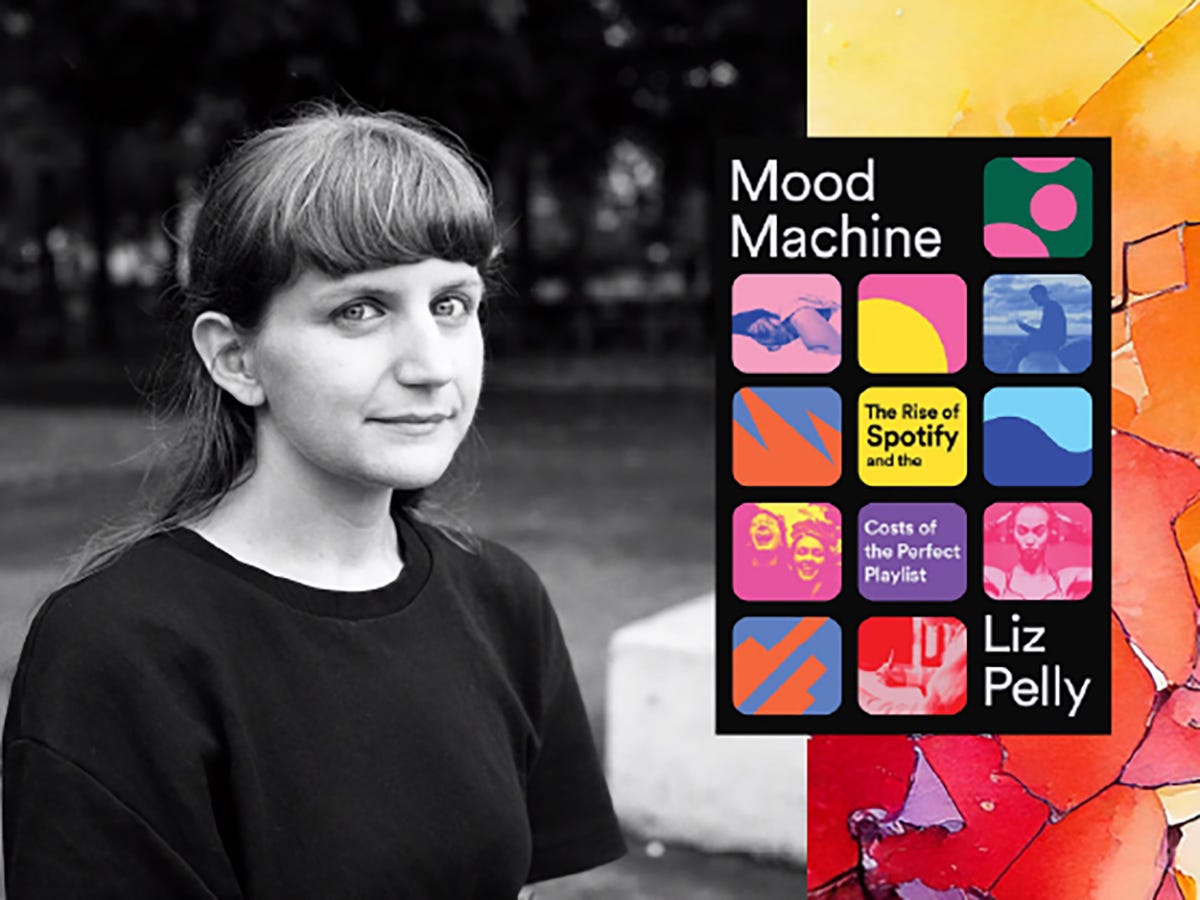
Liz Pelly’s 2025 book “Mood Machine: The Rise of Spotify and the Costs of the Perfect Playlist” represents the most comprehensive investigation into Spotify’s impact on music culture to date. Drawing on over one hundred interviews with industry insiders, former Spotify employees, and musicians, the book reveals how streaming has fundamentally “re-shaped music for listeners and artists alike” through algorithmic manipulation.
The book’s central thesis is devastating!
Spotify doesn’t just distribute music; it actively manufactures moods and manipulates listening habits to maximize engagement and advertising revenue.
The Guardian described “Mood Machine” as “a savage indictment of Spotify,” while readers have called it essential reading for understanding how
“Spotify isn’t a neutral platform; it’s a machine that dictates taste, controls exposure, and re-shapes how we experience sound.”
The book exposes a broader pattern of treating music as “a sonic wallpaper designed to maximize engagement, not creativity.”
The War Machine Investment | From Streaming to Weaponry
While Daniel Ek was publicly positioning himself as a champion of artists and creativity, his private investments told a different story.
Through his venture capital firm Prima Materia (launched in 2021 with a $1 billion commitment to European tech companies,) Ek has poured over €600 million into Helsing, a German-French defence company developing AI-powered military technology.
Helsing specializes in what the industry euphemistically calls “battlefield analysis” and “combat drones,” including the HF-1 and HX-2 “kamikaze” drones that have been deployed in Ukraine. The company is also developing autonomous underwater drones and a full-scale combat drone called the CA-1 Europa. Ek’s investment has made him Helsing’s chairman and primary financial backer.
The ethical implications haven’t been lost on the artist community. As United Musicians and Allied Workers put it bluntly, Ek is
“A warmonger who pays artists poverty wages.”
The union’s characterization captures the grotesque irony.
A CEO who claims insufficient resources to fairly compensate musicians has somehow found HUNDREDS of MILLIONS to invest in weapons technology.The investment has triggered a growing artist boycott, with bands like King Gizzard & the Lizard Wizard, Deerhoof, Xiu Xiu, and others completely pulling their music from the platform. As Deerhoof stated in their withdrawal announcement:
“We don’t want our music killing people. We don’t want our success being tied to AI battle tech.”
The Podcast Pivot | Abandoning Music for Higher Margins
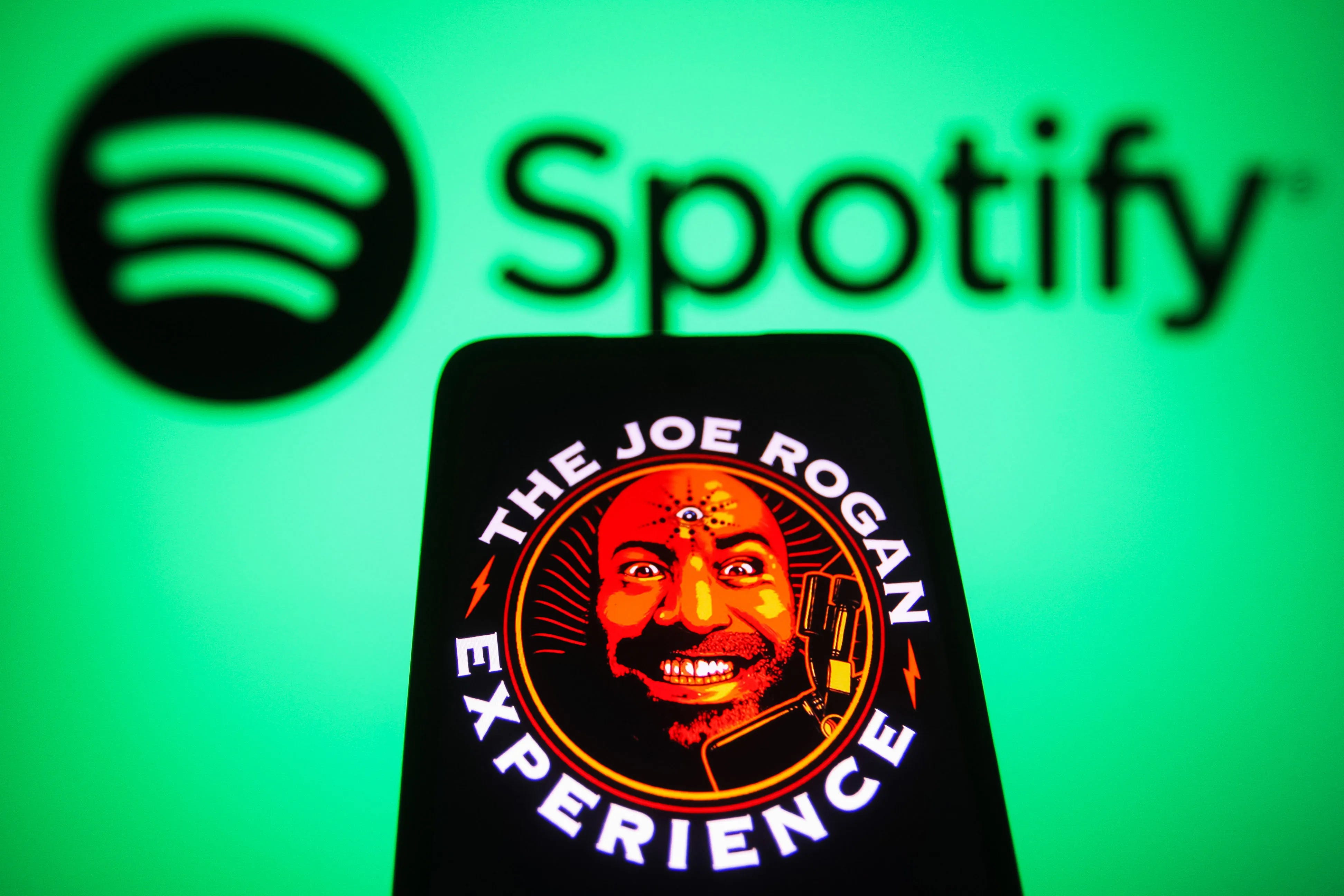
Ek’s diminishing interest in music as an art form became increasingly apparent through Spotify’s aggressive pivot toward podcasts and audiobooks. The company has invested over $1 billion in podcast content, including deals worth $100M+ with figures like Joe Rogan, Theo Von, Alex Cooper etc. while simultaneously tightening the screws on music artist compensation.
This strategic shift makes financial sense from Spotify’s perspective as podcasts and audiobooks offer higher profit margins than music, which requires paying royalties to multiple rights-holders.
By positioning itself as an “audio platform” rather than a music service, Spotify can diversify away from the complicated, relationship-heavy business of working with artists and labels.
Spotify’s AI Future | The Final Displacement of Human Creativity?
Under Ek’s leadership, Spotify has become increasingly aggressive in deploying AI not just for recommendations, but for content creation itself. The platform’s AI DJ feature, launched in 2023, uses generative AI to create “dynamic, narrated listening experiences.” The 2024 AI Playlist feature allows users to generate playlists from text prompts, moving beyond recommendation toward AI-generated curation.
More concerning is Spotify’s apparent preparation for AI-generated music itself. In 2025, the platform deleted over 75 million AI-generated tracks, (that weren’t making them any money) apparently to combat “spam.” This comes after they allowed these AI tracks to be uploaded in the first place, including AI music commissioned by Spotify themselves & AI music appearing on the official pages of dead artists.
However, this action also suggests that Spotify is actively developing policies to manage AI music at scale & preparing for a future where human musicians might be largely replaced by algorithmic content creation.
The company’s AI strategy represents the logical endpoint of Ek’s vision;
A platform where both curation and creation are handled by algorithms, maximizing profit margins while minimizing dependence on human artists who demand fair compensation.
Artists Fight Back | The Growing Exodus
The artist rebellion has been building for years, but Daniel Ek’s defence tech investments have catalyzed a new wave of departures. Beyond the headline-grabbing exits of King Gizzard & the Lizard Wizard and Deerhoof, a growing list of artists including Chad VanGaalen, Kalahari Oyster Cult, Sunnsetter, and Hotline TNT have pulled their catalogues.
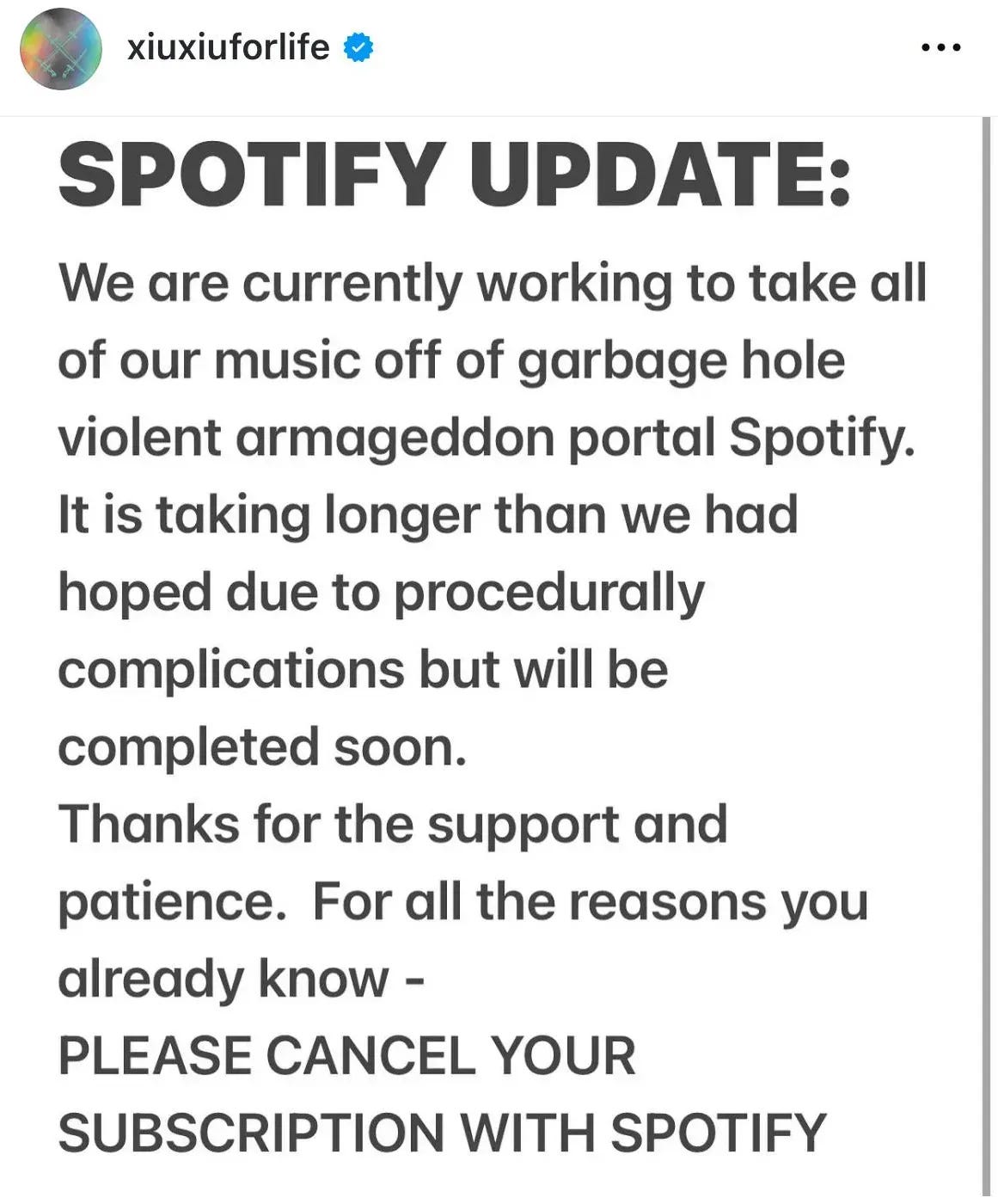
As Xiu Xiu’s Jamie Stewart explained their decision due to Ek’s defence tech investments:
“That wasn’t something we could simply shrug off. We felt there was action we could take regarding that.”
The band described Spotify as a “garbage hole violent armageddon portal” while removing their entire discography. The current exodus feels different. More principled, more permanent, and more tied to fundamental objections about Spotify’s impact on music culture itself.
The New Guard | Business Executives Inheriting a Music Empire
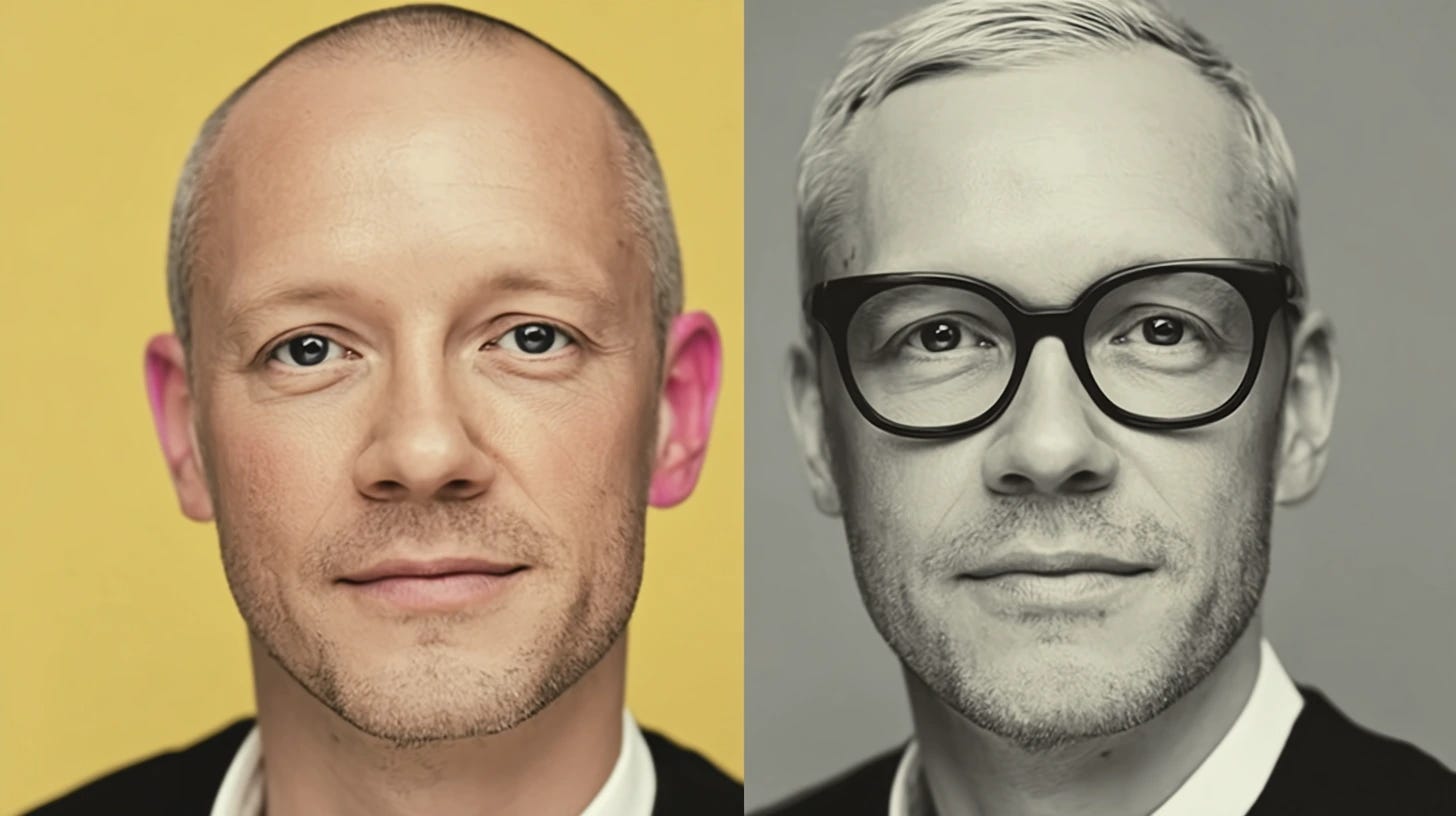
The appointment of Gustav Söderström and Alex Norström as co-CEOs signals the completion of Spotify’s transformation from a music platform to a tech company. Söderström is an engineer who “focused on the technology and product side,” while Norström has handled “business marketing and content.” Neither brings musical expertise or artist advocacy to the role. They are products of Spotify’s algorithmic, data-driven culture.
As Ek noted in his transition announcement, the change “simply matches titles to how we already operate.” For years, the co-presidents have been handling day-to-day operations while Ek focused on his defence tech investments. The leadership transition formalizes what was already happening:
Spotify being run by business executives who view music as data to be optimized rather than art to be celebrated.
The Future of Music in the Post-Ek Era
Daniel Ek’s departure marks the end of an era that many in the music industry will remember as a period of unprecedented disruption and exploitation. While Spotify somewhat solved the piracy problem and made vast catalogues of music accessible worldwide (at their terms), it did so by creating new forms of exploitation that may prove even more damaging to musical creativity and artist sustainability.
The platform’s success has inspired imitators and reinforced industry-wide practices that prioritize algorithmic engagement over artistic discovery, playlist placement over album artistry, and data harvesting over fan relationship-building.
As Liz Pelly concludes in “Mood Machine,” the challenge now is
“What must be done collectively to re-value music and create sustainable systems.”
For Daniel Ek himself, the future appears focused on what he calls helping to create “super-companies” that tackle “some of the biggest challenges of our time.” Given his track record of viewing complex cultural domains through a purely business lens, one can only hope those challenges don’t include anything requiring nuance, creativity, or care for human welfare.
The music streaming wars are far from over, but with Daniel Ek’s departure, they are entering a new phase. One where the original disruptor becomes just another tech incumbent, managed by executives who inherited an empire built on the systematic devaluation of human creativity.
The cost of the perfect playlist, as Liz Pelly’s work reveals, has been the imperfect treatment of the artists who make music possible in the first place.
🫵🏼 What streaming platform do YOU use? Have these revelations about Spotify’s practices changed how you think about music consumption?
💬 Share your thoughts below! This conversation is crucial for the survival of human creativity.
🤝🏼 Join us at Vinyl Culture as we continue exploring ways to preserve and evolve an authentic music culture in an age dominated by algorithms and corporate interests. We are building something that will revolutionize the music industry by creating an Artist-centred and Community-driven platform, leveraging both the offline & online medium. We will empower artists by allowing them to share their art and creativity directly with the fans. More on this soon…
2️⃣0️⃣0️⃣0️⃣+ SUBSCRIBERS have now joined our mission to protect The Soul of Music in the age of algorithmic manipulation & AI. Thanks a lot to each & every one of you!! 🫵🏼 🤝🏼🙌🏻 Together, we can make a difference.


I suppose I'm lucky that I do not need a constant flow of music from a tap... music that I could never actually listen to - a bit like trying to drink a waterfall.
I used no streaming platforms. I buy the music I listen to, except for the radio; which I still use.
Music is big business and there is money to be made, so business men will make it. I'm not sure you can square off musicians wanting their music out there vs artists not wanting to be exploited.
The general public literally do not care if their favourite artist can put food on the table.
I've brought that book btw so hopefully I can find some hope in the music and money world... we live in hope ;)
Sounds like the Peter Daszak of the music mogulry 👏🏼